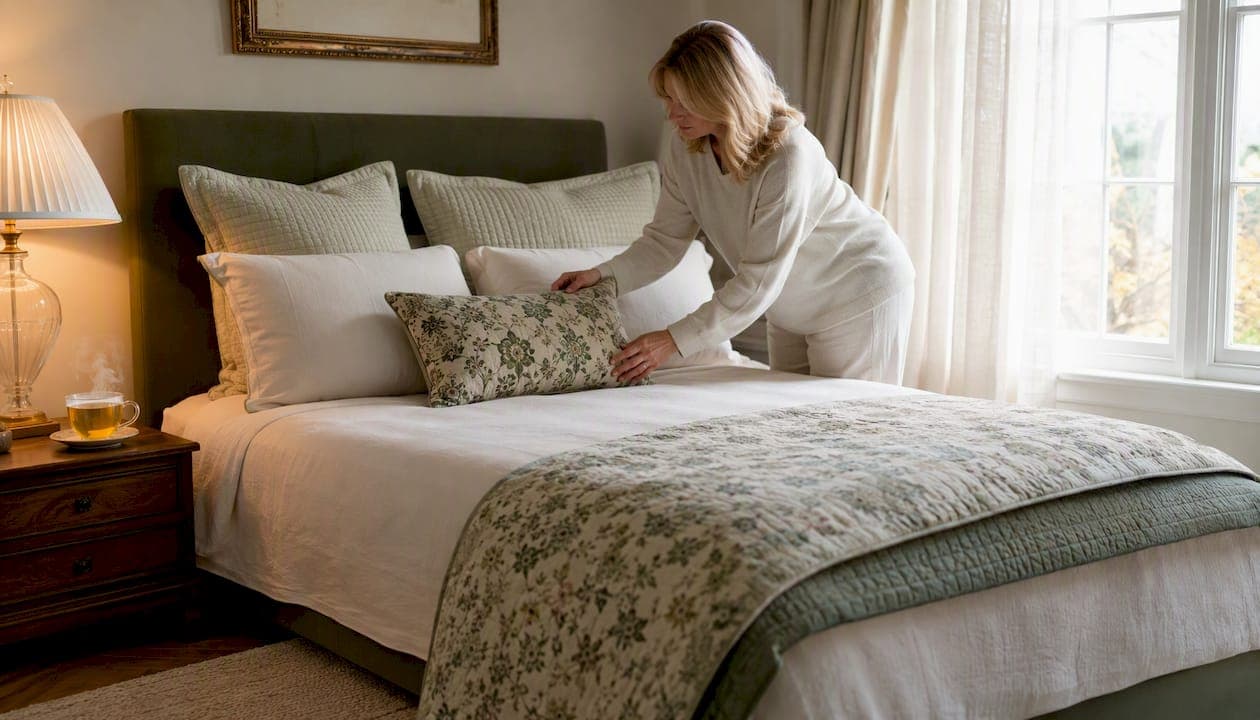
The short answer: a Twin needs a few pillows total, a Full or Queen looks best with a moderate handful, and a King or Cal King can carry several pillows beautifully. That range splits into two distinct jobs: 1–2 sleeping pillows per person for comfort and alignment, plus decorative pillows for proportion and style. Getting that split right is what separates a bed that looks polished from one that just looks piled on.
The 2-2-1 rule gives you the clearest starting point: a couple of sleeping pillows at the back, two shams in the middle, one accent pillow at the front. A few pillows, one cohesive look. Pair that with the rule of odds (groups of three decorative pillows tend to feel more natural and editorial than even pairs), and you have two named formulas that cover most beds.
Here is the practical split at a glance:
- Sleeping pillows: about one or two per person, kept functional and easy to pull out at night
- Decorative shams or Euro pillows: a couple for smaller beds, more for larger beds
- Accent pillows: a few, depending on bed width and headboard height
- Total target: small numbers for Twin, moderate for Queen, larger amounts for King or Cal King beds
Thepetalandporch carries a curated range of decorative pillows and shams that make building this layered look simple, whether you are starting from scratch or refreshing what you already have.
Table of Contents
- How many pillows does each bed size actually need?
- Sleeping pillows vs. decorative pillows: how many do you really need?
- What designer styling formulas actually work?
- Which pillow sizes create the best proportion?
- How to arrange your pillows in five minutes
- Keeping your bed functional: storage, cleaning, and daily resets
- Common pillow styling mistakes and how to fix them
- Curated picks from Thepetalandporch for a starter styling set
- Key Takeaways
- A warm note from Thepetalandporch
- Shop a starter pillow set from Thepetalandporch
- Sources and further reading
How many pillows does each bed size actually need?
This table gives you a single reference point for every mattress size, so you can stop guessing and start placing.
| Mattress Size | Sleeping Pillows | Shams / Euro Pillows | Accent Pillows | Total Range |
|---|---|---|---|---|
| Twin | 1 | 1 sham | 1 small accent | 2–3 |
| Twin XL | 1–2 | 1 sham | 1 accent | 2–3 |
| Full / Double | 2 | 2 standard shams | 1 accent | 4–5 |
| Queen | 2 | 2 shams or Euros | 1–2 accents | 5–7 |
| King | 2–4 | 2–3 Euros | 2–3 accents | 7–9 |
| Cal King | 2–4 | 2–3 Euros | 2–3 accents | 7–9 |
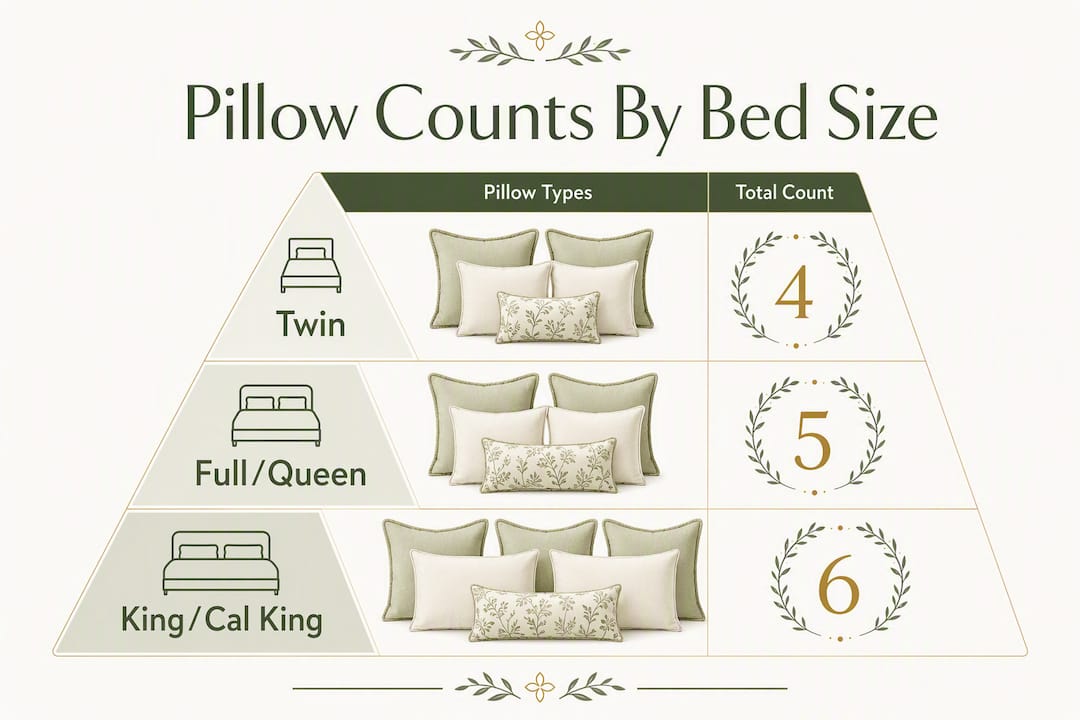
A Queen bed at five pillows (two sleepers, two shams, one lumbar accent) hits the sweet spot most designers recommend. A King with nine pillows sounds like a lot until you see how much visual space that wide mattress actually has to fill.
Two things shift these numbers: headboard height and bedroom scale. A tall upholstered headboard can support a full Euro row behind the shams. A low platform bed or a petite room looks cleaner with one fewer layer. Personal comfort matters too — if you sleep with three pillows for medical reasons, build your decorative count around that reality rather than fighting it.
Sleeping pillows vs. decorative pillows: how many do you really need?
Most people sleep with one pillow, and that is usually enough. Side and combination sleepers often benefit from two, since the extra height keeps the neck aligned with the spine through the night. Using more than three pillows for sleep tends to push the head forward and strain the neck, so the ergonomic sweet spot stays firmly at 1–2 per person.
Your sleep position shapes that number:
- Back sleepers: one medium-loft pillow, centered under the head
- Side sleepers: one firmer, higher pillow to fill the gap between ear and shoulder; a second between the knees adds hip support
- Stomach sleepers: one very thin pillow or none at all to avoid neck rotation
- Combination sleepers: two softer pillows that can be stacked or separated as needed
Decorative pillows serve a completely different purpose. They create proportion, add color and texture, and make the bed look intentional during the day. They are not meant to sleep on. Keep them easy to remove: a quick toss to the foot of the bed or into a nearby basket takes ten seconds and keeps your sleeping setup clean.
Pro Tip: Choose decorative pillows with removable inserts so you can swap covers seasonally without buying new pillows. It keeps the look fresh and the storage footprint small.
What designer styling formulas actually work?
The 2-2-1 rule is the most reliable formula for a Full or Queen bed. Two sleeping pillows sit flat against the headboard. Two matching or coordinating shams layer in front of them. One accent pillow — a lumbar, a bolster, or a smaller square — anchors the front. The result is a layered, graduated look that reads as intentional without requiring any design experience.

The rule of odds takes a slightly looser approach. Designers consistently point to three decorative pillows as the "magic number" for a relaxed, editorial feel. Three pillows in varied sizes and textures look curated rather than matched, which is exactly the effect most people are chasing. Two matching pillows can feel stiff; four can feel crowded. Three, especially in an asymmetric arrangement, hits a natural balance.
The five-pillow theory is worth knowing, though it is more of a comfort framework than a strict styling rule. It argues that multiple pillows can serve distinct support needs across the body. Designers borrow the number (five) as a practical target for Queen beds because it fills the width without overwhelming the space.
On the question of stacking style: looser, layered arrangements are easier to live with than rigid pillow walls. A tall, perfectly symmetrical stack looks beautiful in a photo and takes four minutes to rebuild every morning. A relaxed, slightly varied stack looks just as good in person and takes thirty seconds to reset.
Pro Tip: For a King bed, try a slight asymmetry in your accent layer: one lumbar on the left and two smaller squares on the right. It feels more organic than a perfectly centered single pillow and gives the wide mattress a sense of movement.
Which pillow sizes create the best proportion?
Pillow dimensions determine how your arrangement reads from across the room. Here is how the main types work and which beds they suit best.
| Pillow Type | Dimensions | Visual Role | Best For |
|---|---|---|---|
| Euro sham | 26 × 26 in | Creates height and back structure | Queen, King, Cal King |
| Standard sham | 26 in | Mid-layer filler, pairs well with Euros | Full, Queen |
| King sham | — | Wide back layer, replaces Euros on King | King, Cal King |
| Lumbar | — | Grounds the front layer, adds horizontal line | All sizes |
| Bolster | Cylindrical, varies | Focal point accent, works on smaller beds | Twin, Full, Queen |
| Small square accent | 18 × 18 in | Front pop of color or texture | All sizes |
Euro shams at the back solve the most common proportion problem: accent pillows that look visually lost in front of flat sleeping pillows. The height cascade that Euros create gives smaller pillows something to lean against and makes the whole arrangement read as layered rather than flat.
On a Twin or Twin XL, skip the Euros entirely. The mattress is not wide enough to carry three 26-inch squares without looking crowded. One standard sham and one small accent is plenty. On a King, two or three Euros across the back give the wide surface the structure it needs before you add shams and accents in front.
A lumbar pillow is one of the most underused tools in a bed arrangement. It sits at the front of the stack, runs the width of the bed (or close to it), and grounds the whole composition with a strong horizontal line. One lumbar often replaces two or three smaller accent pillows and makes the bed look cleaner.
How to arrange your pillows in five minutes
This formation works on any bed from Full to King. Adjust the number of pieces per the cheat sheet above, but the sequence stays the same.
- Lay sleeping pillows flat against the headboard, side by side. Fluff them fully before placing.
- Add Euro shams (if your bed size calls for them) directly in front of the sleeping pillows, standing upright. Center them evenly across the mattress width.
- Place standard or king shams in front of the Euros, also upright. Align the bottom edges with the top of the mattress fold.
- Set your accent pillow or lumbar centered at the very front. For a lumbar, lay it horizontally. For a square accent, stand it upright and angle it very slightly if you want a relaxed feel.
- Step back and check the center line. The arrangement should read as symmetrical from left to right, with a clear height cascade from back to front. Adjust any pillow that leans or gaps.
For a low headboard, skip step 2 entirely and rely on the shams as your tallest back layer. For a very tall headboard, you can add a second Euro row or use king shams instead of standard ones to fill the vertical space.
Aligning the seams of your shams so they face the same direction takes five extra seconds and makes a visible difference in how finished the bed looks.
Keeping your bed functional: storage, cleaning, and daily resets
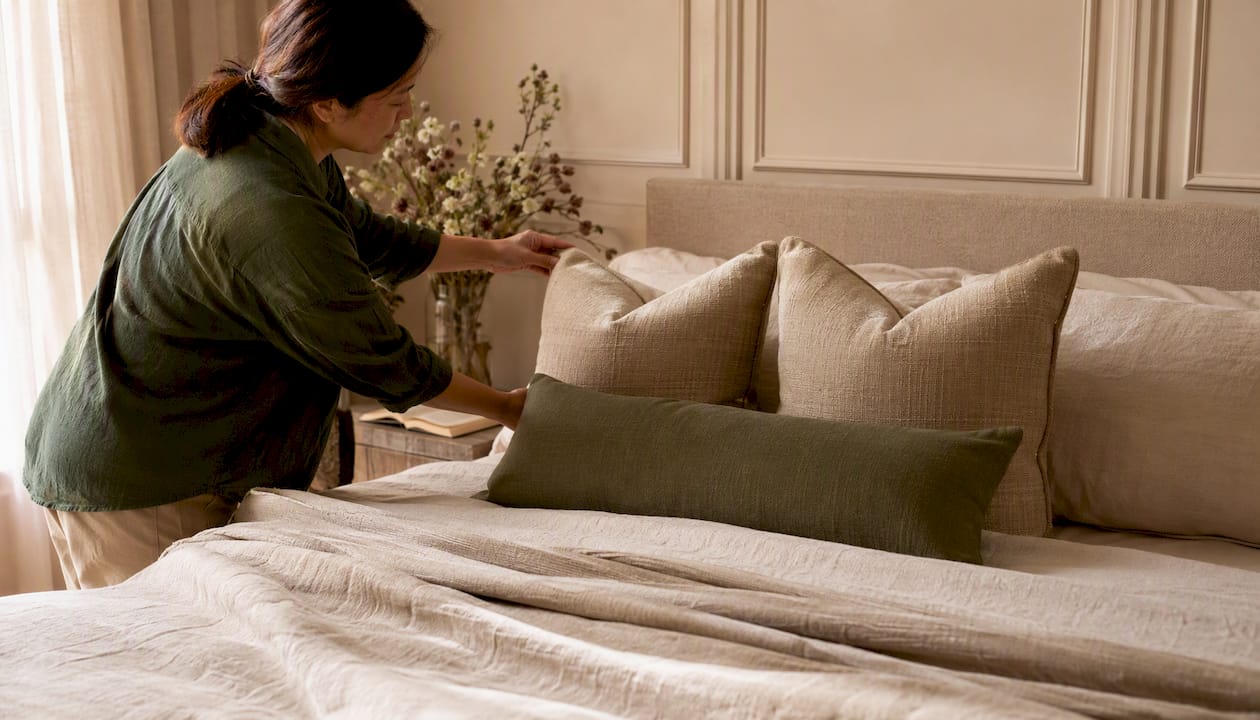
The real limit on how many pillows you can have is not your mattress size. It is your willingness to move them every night. If your decorative pillows routinely end up on the floor, that is a clear signal to remove one or simplify the arrangement.
Three storage options that actually work:
- A woven basket at the foot of the bed holds two to four accent pillows and looks intentional rather than messy
- A flat under-bed bin works well for Euro shams you only use during the day
- A breathable cotton pillow bag protects decorative covers from dust if you store them in a closet
For cleaning, most decorative covers can be machine washed on a gentle cycle. Inserts are a different matter. Down-alternative inserts typically last two to three years before they lose loft; foam inserts can go longer but may yellow. When an insert no longer holds its shape after fluffing, replace it.
Pro Tip: Choose firm, high-loft inserts for all your decorative pillows. A structured insert keeps the pillow looking full and magazine-fresh without daily re-fluffing. Low-density fills collapse within weeks and flatten the layered look you worked to build.
Common pillow styling mistakes and how to fix them
Most beds that look "off" share one of these problems:
- Too many matching pillows — A set of four identical pillows reads as a department-store display. Fix it by swapping one for a different texture or a contrasting lumbar.
The simplest test for "too many pillows": if you cannot remake the bed in under three minutes on a busy morning, the arrangement is working against your lifestyle. Remove one layer and see if the bed still looks complete. It usually does.
Curated picks from Thepetalandporch for a starter styling set
Building a layered bed arrangement is much easier when the pieces are already coordinated. Thepetalandporch carries a range of decorative pillows and covers designed to work together without looking matchy.
A practical starter set for a Queen bed might include:
- Two Euro-style decorative pillow covers for the back layer, in a neutral or botanical print that anchors the palette
- Two standard shams in a complementary solid or subtle texture for the mid-layer
- One lumbar accent cover at the front to ground the composition with a horizontal line
For a King, add one more sham pair and a second accent square to fill the wider surface. Mixing textures (a woven cover next to a smooth satin or a soft cotton) gives the arrangement depth without requiring multiple colors.
Pro Tip: Prioritize covers with structured, removable inserts. Thepetalandporch's decorative pillow collection includes options with firm fills that hold their shape nightly, so your arrangement looks just as good on day thirty as it did on day one.
Thepetalandporch offers free shipping on orders over $34.99, so a starter set of two to three covers ships at no extra cost. Browse the full collection and mix textures to build a layered look that feels personal, not catalog-perfect.
Key Takeaways
The right number of pillows on a bed depends on mattress size and purpose: 1–2 sleeping pillows per person plus 2–5 decorative pieces gives you a balanced, functional arrangement on any bed from Twin to Cal King.
| Point | Details |
|---|---|
| Count by bed size | Twin: 2–3 total; Full/Queen: 5–7 total; King/Cal King: 7–9 total. |
| Sleeping pillow rule | Use 1–2 sleeping pillows per person; more than three risks neck and spine alignment. |
| Use the rule of odds | Three decorative pillows create a relaxed, intentional look that pairs and fours rarely match. |
| Choose firm inserts | High-loft, structured inserts keep decorative pillows looking full without daily re-fluffing. |
| Thepetalandporch starter set | Euro covers, a lumbar accent, and coordinating shams from Thepetalandporch build a layered Queen or King arrangement with free shipping over $34.99. |
A warm note from Thepetalandporch
At Thepetalandporch, we believe a beautifully made bed is one of the simplest ways to make a home feel like a sanctuary. Every pillow cover and decorative accent in our collection is chosen with that in mind: pieces that layer well, hold their shape, and bring a little warmth into the room without requiring a design degree to arrange.
Our focus has always been on quality over quantity. We carry structured inserts, botanical prints, and textured covers that mix naturally together, so you can build the layered look this guide describes without hunting across a dozen different stores. Free shipping on orders over $34.99 makes it easy to start small and add as you go.
Shop a starter pillow set from Thepetalandporch
Ready to put this guide into practice? Thepetalandporch's home decor collection includes Euro-style covers, lumbar accents, and coordinating shams that are ready to layer on any bed size.

Every piece ships free on orders over $34.99, and the collection is curated so the textures and tones work together from the start. Pick two covers for a minimal look or build a full five-piece Queen arrangement. Either way, you will have a bed that looks styled and still sleeps well. Browse the collection and find your starting point today.
Sources and further reading
The claims and recommendations in this guide draw from the following sources:
- How many pillows should you sleep with? — Ergonomic guidance on sleeping pillow counts by sleep position and alignment needs, including per-size styling charts.
- How Many Pillows Should Be on a Bed? — Designer-sourced total counts by mattress size and practical advice on storage and daily reset routines.
- Designers Agree: This Is the Only Bed Pillow Styling 'Rule' Worth Following — House Beautiful's coverage of the rule of odds and why three decorative pillows is the designer consensus.
- Pillow arrangement guide — Practical guidance on Euro sham placement, height cascades, and insert quality for lasting shape.
- Thepetalandporch home decor collection — Curated decorative pillows, Euro covers, and lumbar accents for building a layered bed arrangement.